
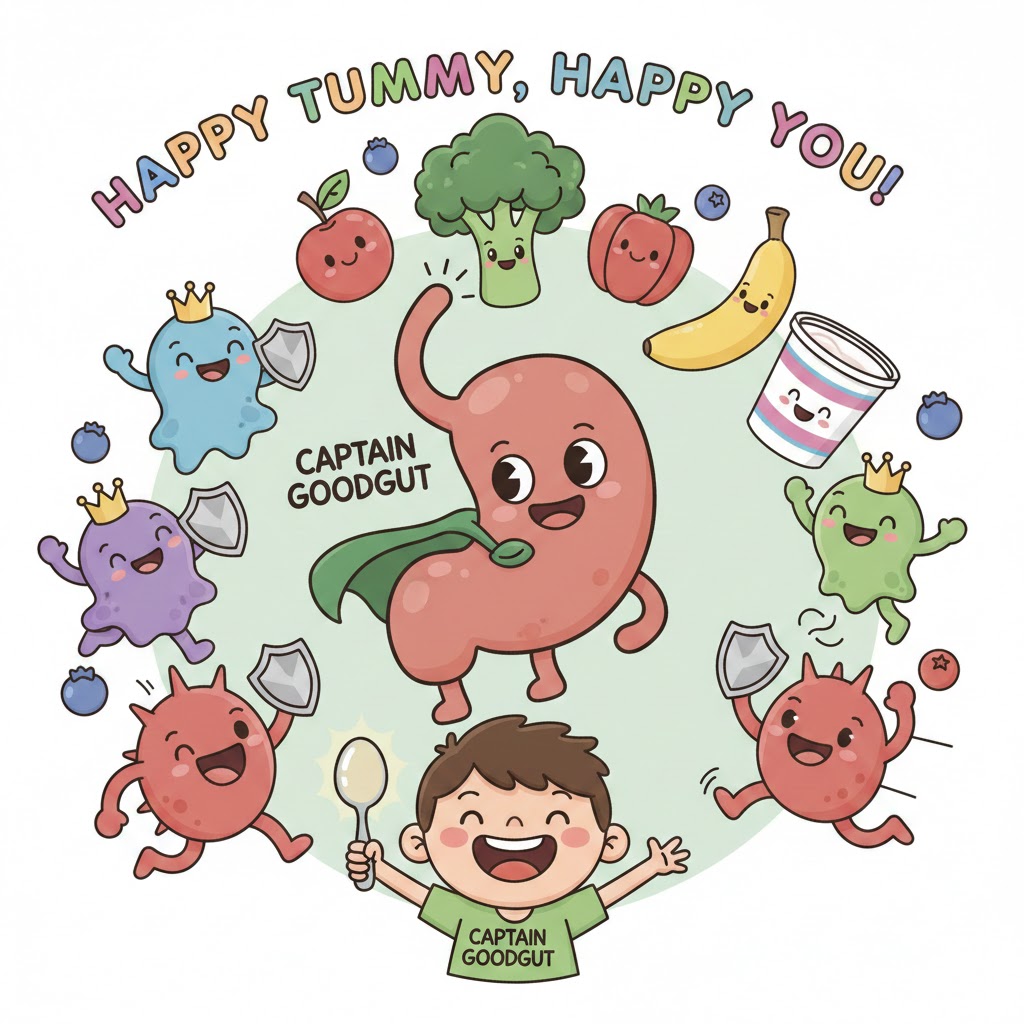
Kids face multiple gut-health issues these days. Kids’ gut nutrition to eat smart and feel better is a very important phenomenon.
An important consideration is that working parents find it difficult to manage a good schedule for kids, because Kids are kids. I recently got feedback from a working mother that discipline has actually made things easier for her and her 2 daughters (Age 2 and 9).
1. Kids are not born with Earth Schedules
Yes, that’s the most challenging part. Working parents had a good schedule before kids were born. But an infant hasn’t adjusted to the circadian rhythm yet. Few wonder kids might have a good schedule from the beginning, mostly they do not.
Firstly, make sure new parents get a lot of help; if the family isn’t living together, then hire help. That’s important if both parents are working. Even during the maternity leave. It actually takes a village to raise a child. If the parents are not panicked, it is easier to form schedules.
Try to fix the sleep schedule by the end of the first year. Why is that important for gut-health?
Let’s take the reverse situation. If a child doesn’t have a proper sleep schedule, they will sleep late and get up late. Bowel movement, breakfast, all will be late. Gut microflora starts changing that way and affects gut health.
This might/ might not show a huge impact till the child starts going to school. For example, if the child clears bowel by 11 am and eats breakfast by 10 am, once school starts, the school timings will interfere with this schedule. Now the child will refuse to eat breakfast, might not eat tiffin too, and release bowel movements after coming home from school. Early schools are 1-2 hours, but this time gap increases with age. I have a 10-year-old client who releases his bowels around 9-10 am on holidays and after 3 pm on school days.
So basically, he is avoiding voiding his bowels in school and holding till he returns home. That also makes him feel bloated, hence not willing to eat breakfast/tiffin.
This is not one case; it is very regular among urban kids. Hence, try to make the child eat early dinner and sleep by 8:30pm-9pm. Make sure this habit is created before the schooling starts. Talk to elders/ friends/ therapists for help if you find this challenging.
1 tip would be to create a sleeping environment at the required time, tell the child songs/ stories, and they will fall asleep. If it’s a habit, there will be fewer deviations; if not, then deviations will be frequent.
2. They need to drink water
By hook or by crook, you have to make them a habit of drinking water. You know your child, do whatever it takes to build that habit. Saam, daam, dand, bhed, anything.
And please, it has to be water, not juice, not cola, not soups, & no milk, and lassi also does not suffice for water, tender coconut water or lemon water is still ok, and please no tea/ coffee at all.
1 tip, you drink water well, if parents have the habit, kids copy.
How much water has to be given?
For children 11 kg to 20 kg, the daily water requirement is 100 ml/kg for the first 10 kg and 50 ml/kg for every kg above 10 kg. For children above 20 kg, the fluid requirement is calculated as 1500ml for 20 kg and 20 ml/kg for every kg above 20 kg, but more than 2400ml of fluid should not be administered at once.
Kids need fiber too!
The common notion is, let them eat whatever they want, at least tummy is full. They will learn to eat healthily once they grow up.
- They will not learn to eat healthy food unless they are taught right from the beginning.
- Most kids refuse fruits and vegetables, and other fibre-rich foods specifically. That hampers gut health and results in frequent gut-issues.
- Give them what everyone eats. I am suggesting that hoping the elders in the family eat healthily. If not, then let’s be very clear, child will learn fron what you do and not what you say.
I have a friend who is in their late 20’s and had a baby recently. She said, “Meri habits to kharaab hai diet mei, mei baby ki achi daalungi” Now, since she didn’t ask for advice, I couldn’t give. But I am pretty sure the kids would also learn to eat noodles, & not salads.
Final Word
One can discuss a lot of points to guide kids’ gut health and nutrition. A blog is too small for the same. Connect with dietitian Anuradha and regular counselling sessions can help you fix the gut-issues.
